)
Top Drives Patch-Notes
Oct 5, 2026 / 30 min read
Update 32.5 - Nightmare on the Tarmac!

🎃 THE TORN BESTIARY - 13 ACCURSED VARIANTS ARE UNLEASHED UPON THE TRACK!
Spooky season descends upon the Top Drives! Hunt 13 variants down across the season to complete the set and bring their reign of terror to a halt! Massive rewards await any monster hunters up to the task...
Trick or Treat tokens will be hidden throughout Top Drives, across every game mode - each one could earn you a killer reward... or a handful of dust!
More details will follow, so check back for updates! In the meantime, let's take a closer look at what's coming your way 👻 👇🏻
2015 Dodge Challenger SRT Hellcat
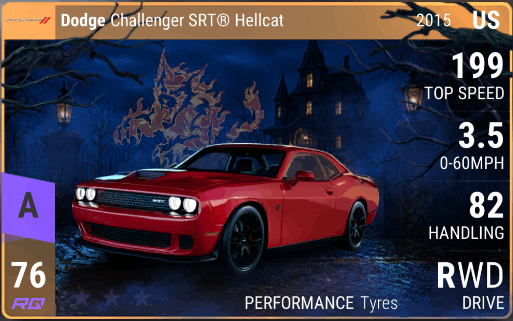
Some of the earliest Dodge Chargers had less than 200bhp when the car was launched back in 1970. Fast forward 45 years, the Challenger SRT Hellcat had a simply terrifying 707bhp - how’s that for progress?
Dealing a constant blow to its rear tyres, the 2015 Challenger SRT Hellcat was fitted with a supercharged 6.2-litre V8, producing 650lb ft of torque alongside that headline-grabbing power figure. To keep owners safe, it even came with two keys, a black key for everyday use which limited the engine to 500bhp, and a red key for the all-guns blazing V8 experience. Drive one if you dare.
1991 Peugeot 905 Spider
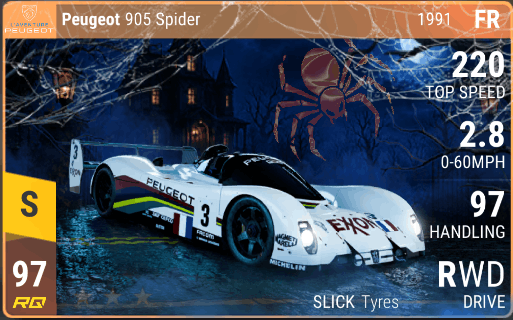
If the looks don’t scare you, having 650bhp in a car that weighs only 780kg certainly will. The 905 Spider was first seen in 1991, destined to be raced in a future Peugeot one-make race series called the 905 Spider Cup. It may not have had the wailing 3.5-litre V10 engine of its more extreme Le Mans-contending 905 sibling, but it still featured advanced aerodynamics and scintillating performance.
The 905 Spider could hit 220mph flat-out, a mighty speed given its open-air cockpit. Very few examples were produced, and with a four-cylinder engine it isn’t held in as high regard as its V10-powered brother. Even so, to push one to the limit takes serious bravery.
2021 Cadillac CT4-V Blackwing
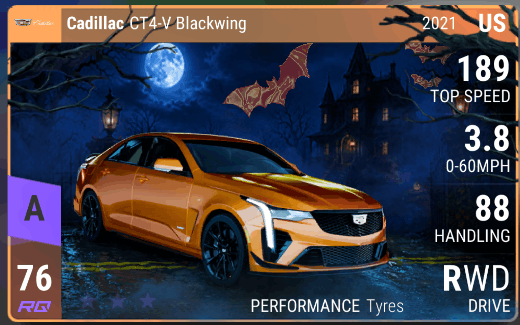
On the face of it, the Cadillac CT4-V Blackwing is just another American sedan, a big, comfy and inoffensive way of getting from A to B. But the Blackwing name denotes a somewhat more sinister character.
Under the hood lies a twin-turbocharged 3.6-litre V6 engine, good for 472bhp and 445lb ft of torque. The CT4-V Blackwing will manage 0-60mph in 3.8 seconds, on its way to a top speed of 189mph, enough performance to embarrass supercars from 20 years ago. Its looks might let it float under the radar, but underestimate its abilities at your peril.
2009 Lamborghini Murciélago LP 670-4 SuperVeloce
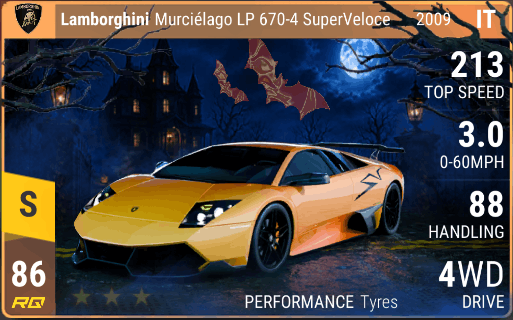
The Lamborghini Murciélago LP 670-4 SuperVeloce, or LP 670-4 SV for short, was a significant halo model for the Sant'Agata Bolognese manufacturer. Not only was it the final version of the Murciélago, which was poised to be replaced by the Aventador, but it also marked the end of the road for its 6.5-litre naturally aspirated V12 engine, an engine that could trace its roots all the way back to cars like the original Miura back in the 1960s.
With such heritage, Lamborghini created the ultimate take-no-prisoners Murciélago. The engine produced 670bhp, with power going to all four wheels via a six-speed automatic gearbox, and 100kg was stripped from the car to make it the lightest and most focussed Murciélago yet. Even with all-wheel drive, carbon ceramic brakes and huge tyres, one wrong move and the LP 670-4 SuperVeloce would bite. If a big, scary Lamborghini is what you desire, look no further.
1970 AMC Gremlin
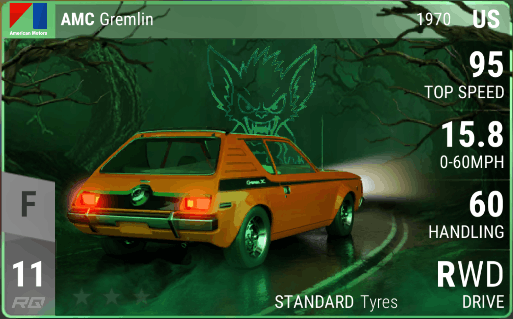
Of the many cars in the Top Drives stable, the AMC Gremlin is far from the most intimidating. But are there many more dark and freaky names than Gremlin?
Even in the decade of platform shoes and pet rocks, the AMC Gremlin’s funky styling enabled it to stand out from the pack when it launched in 1970. But the styling stemmed in part from the Gremlin’s mechanical layout, with a heavy 3.3-litre straight-six engine up front and rear-wheel drive at the back. As a result, the Gremlin had a quiet habit of snapping into a surprise slide in the wet. Perhaps the Gremlin could increase the pulse rate in all the wrong ways.
2022 Ford Ranger Raptor V6
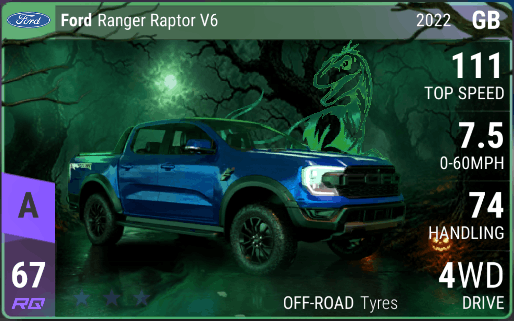
You’d think a V6 pick-up truck would be tame compared to one with a V8 or V10 engine, right? In the case of the Ford Ranger Raptor V6, that’s absolutely not the case.
Driving all four wheels is a twin-turbo 3.0-litre EcoBoost V6, with a modest 288bhp. That’s plenty of shove for any vehicle, but a high-riding truck with no weight over the rear axle and off-road tyres? Yeah, that’s plenty. On tarmac, the Ranger Raptor V6 is quick but should always be driven with care, while on gravel or snow there’s sideways hilarity as standard.
2022 Dodge Hornet GT
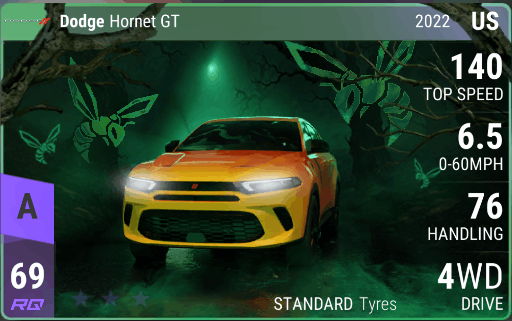
You don’t need a microscope to spot the Dodge Hornet’s likeness to the Alfa Romeo Tonale - the underlying extended family resemblance is as clear as day. But where plenty of Tonale buyers will get their hands on a car with a powertrain built for efficiency, the shortlived Dodge Hornet - sold for only two years in the USA - gave little consideration to fuel saving.
The entry-level Hornet GT was a straight-up petrol lover, its 2.0-litre four-cylinder engine going without the hybrid assistance of its more expensive Hornet R/T sibling. Even so, it was no slouch, able to crack 60mph in 6.5 seconds. The Hornet GT may have been laid to rest, but we’re secretly hoping it rises up once more to haunt its Alfa Romeo cousin.
2021 Chevrolet Beast
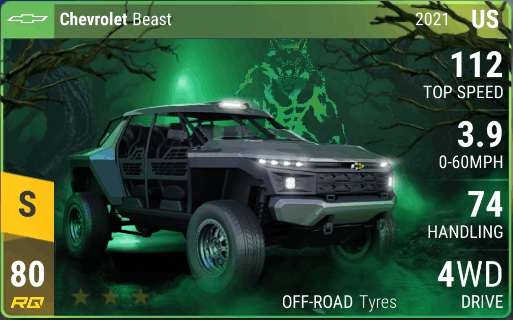
Imagine you’re hiking across a mountainous landscape. You’re tired, you haven’t seen or spoken to anyone in several days, and distant sounds of bears, wolves and other predators keeps your heart rate high, adrenaline pouring through your system. Then you hear a sound, a thunder that’s growing louder and louder, and fast. You start running, only to turn around and see this, the Chevrolet Beast. It might not be a bear, but your heart rate isn’t going to be coming down anytime soon.
Revealed in 2021, the Chevrolet Beast is an all-wheel drive monster that makes other off-road machines look as though they were designed to conquer a sand pit. With 13.5 inches of ground clearance, 37-inch off-road tyres and a super-aggressive bodywork, the Beast wouldn’t look out of place driving round on an alien planet. Plus, with a 6.2-litre, 650bhp supercharged V8, its bark is loud and its bite strong. Other cars only continue to exist because the Chevrolet Beast allows them to.
1984 De Tomaso Pantera GT5
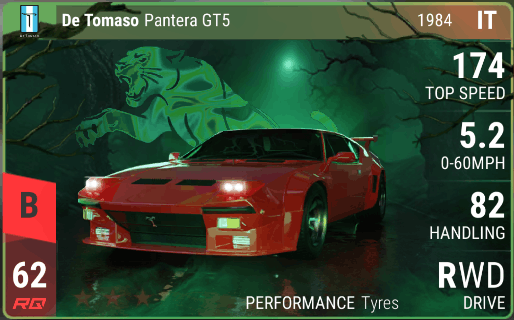
If you know anything about cars you’ll know about the De Tomaso Pantera. What began as a pretty, V8-powered mid-engined, rear-wheel drive sportscar gradually morphed into an aggressive and unforgiving brute: the De Tomaso Pantera GT5.
Having got involved in 1970, Ford decided to sell its stake in De Tomaso in 1974, returning all of its shares in the company to its founder, Alessandro de Tomaso. The Argentinian businessman and racing driver then set about escalating the Pantera’s performance levels, until in 1980 the GT5 was born. It had a short 2.5m-long wheelbase, with a 355bhp 5.7-litre Ford engine slapped just inches behind the cockpit. With a limited-slip differential, a five-speed manual gearbox and no ABS or traction control, one lapse in concentration behind the wheel would see the Pantera GT5 fight back against the driver.
1965 AC Cobra MkIII 427 S/C
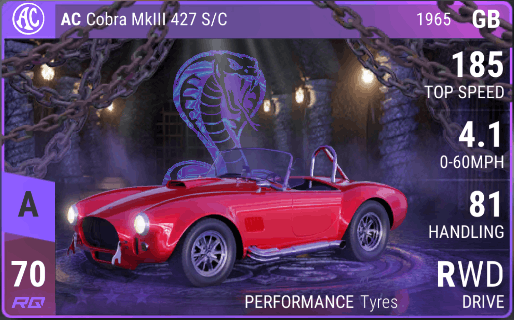
The AC Cobra name is legendary. Quite apart from its success on the race track, some models were as ferocious and dangerous as its serpentine namesake. One such model is the Cobra MkIII 427 S/C.
Powered by a 7.0-litre V8 engine, the Cobra MkIII 427 S/C sits with purpose and menace even today. Tipping the scales at only 1,147kg and with 485bhp on tap, constant care and attention is needed to drive these brutal and physical machines quickly. Very few drivers can truly get the most out of a Cobra MkIII 427 S/C - are you one of them?
2021 Hennessey Venom F5
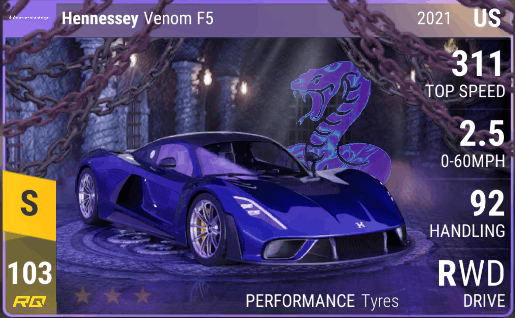
In a classic case of ‘hold my beer’, John Hennessey looked at his rivals from Bugatti, Koenigsegg and Rimac, took off his cowboy hat and set about throwing punches. Having already created the Venom GT back in 2010, a car that set numerous acceleration records and could hit 270mph, the Hennessey team’s second album launched in 2021: the Venom F5.
Anyone courageous enough to sample the Venom F5 will soon feel the full force of the Hennessey-made 6.6-litre, twin-turbo V8 ‘Fury’ engine. Throwing out 1,817bhp, your eyes will barely be able to keep up as you fire through 62mph in 2.5 seconds and 186mph in 8.4 seconds, on your way to a top speed of 311mph. There aren’t many cars that could make Hennessey’s home state of Texas feel small, but the Venom F5 is one of them.
2023 Fiat 500e Scorpionissima
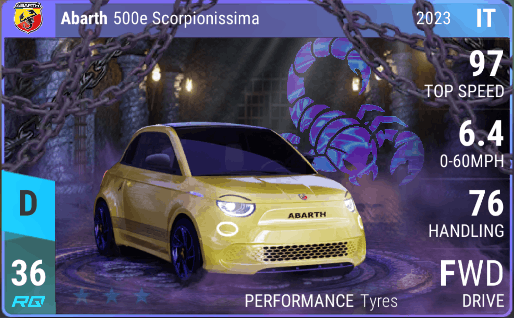
How do you launch an all-electric follow-up to a petrol-powered hot hatchback? Load it full of kit, paint it a bright colour, give it loads of power and name it ‘Scorpionissima’, that’s how.
The modern Abarth version of the Fiat 500 wasn’t loved universally, but it certainly had its fans. Which is why replacing it with a model based on the all-new and all-electric Fiat 500 presented some hurdles but also a great deal of opportunity. Thankfully the resulting 500e Scorpionissima, the launch version of the Abarth-tuned electric Fiat 500, was received as an acceptably entertaining successor. With 150bhp and a 0-62mph time of 7.0 seconds, it might not scare you but it still boasts a decent sting in its tail.
2016 Dodge Viper ACR
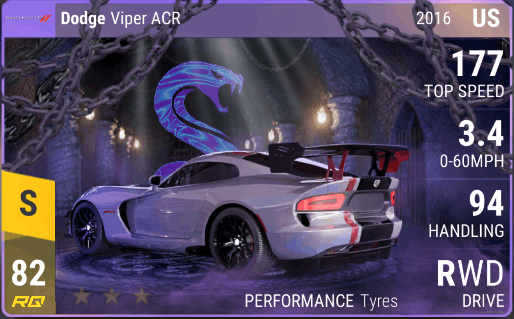
Few cars carried such a menacing reputation as the original Dodge Viper, which was created at a time when cars that were downright difficult to drive were somewhat celebrated, rather than seen as potential law suits. And yet when the fifth generation Viper launched in 2013, its table manners had improved but it was still perfectly capable of knocking you out cold. Taking that to the extreme was the Dodge Viper ACR, one of the final Viper variants and one that would take a great deal of pleasure in surprising you to the point your life would flash before your eyes.
Released from its cage in 2016, the Viper ACR had a huge rear wing and aggressive front splitter, an uprated carbon ceramic braking system, a more track-focussed suspension set-up and super sticky tyres. All of that combined with an 8.4-litre V10 engine with 645bhp and 600lb ft of torque going to the rear wheels. Drive one and you’ll need to have your wits about you. Drive one hard and you’ll want to say a prayer.
⚔ A NEW RIVALS BATTLE IS WAITING FOR YOU SOON!
Legrand and Leoni return - though you may not recognise them...
🛒 HALLOWEEN-EXCLUSIVE OFFERS!
Stay tuned for more news!
📌 DOTNET RESOLVER
In this patch, we've made some fundamental changes to our race simulation logic in Top Drives. The original race simulation logic for Top Drives was written in 2015, and it's been through many changes in the 11 years since and it was in need of modernisation. The race simulation was running on outdated server hardware, built with an old version of our software tools, and hadn't undergone any recent optimisations.The race simulation itself generates a very large set of data: each car, track, and upgrade combo yields a unique race result. With 579 tracks, roughly 6,250 cars, and 990 upgrade combinations per car, there are over 3.5 billion possible race results in the game. We can't test all of those directly, but for this patch we ran and compared roughly 2 million real race results between the old and new simulation, across every track and a representative spread of cars and tuning levels, to make sure the changes hold up.
Running the simulation on older hardware was taking its toll on our ability to make the changes we really wanted to. We'd love to be able to refine the race simulation to make it better, but knowing we had to run it for extended periods to generate new results was holding us back from making larger changes.
To address this, we've spent the past few months slowly working on updating the race simulation to run on newer server architecture, using the latest development tools and available optimisations.
Due to how the new hardware handles calculation of floating point numbers, results from the new simulation came out very slightly different, changes on the order of thousandths of a second. Normally we wouldn't worry about changes that small, but they were amplified by some design decisions we'd made in the past.
I'm going to go through those decisions and why I think the fixes we made actually make Top Drives more accurate, more fair, and more enjoyable.
Hurdle #1: Race finish time
We previously reported the finish time in 1/60th-of-a-second increments, the equivalent of saying "you finished this race in this frame." That was causing races to tie whenever two similarly paced cars finished within about 16 milliseconds of each other. It also meant a tiny change to a car's true finish time could bump it into the next frame, sometimes causing a large ranking change for what was really a negligible difference.
The fix: we now calculate the exact moment a car crosses the finish line, instead of rounding up to the next frame. That has broken a lot of previously "tied" races, since each car now reports the moment it actually crossed the line rather than the frame it happened to land on. On its own, this change only ever makes a car's reported time equal or faster than before, since we're removing rounding, not adding it. It can still shuffle rankings, but the result is more correct.
Hurdle #2: Car position accuracy on the track
Previously, cars used their location on the track to look ahead and decide their next move, based on the car's performance and stats. The hardware change meant tiny shifts in car position were leading to noticeably different decisions. In some cases, upgraded cars would brake earlier than non-upgraded ones, making them slower when we'd expect the opposite.
On many tracks, faster cars would also get a little indecisive right before a corner: easing off the brake, then reapplying it a beat later, instead of committing to one clean brake. That introduced a small amount of randomness into results, usually tiny, but occasionally enough to let a less-upgraded car beat a more-upgraded one.
The first fix: every car behaviour decision now applies the moment the car crosses the point where it should make that decision, not just at the start of its next frame of movement. A car on the edge of a braking zone now correctly registers entering it and brakes at the right moment, instead of waiting for the next frame.
The second fix: we reworked how a car decides when to start braking for a corner and, just as importantly, when it's actually safe to get back on the throttle. Every car now goes into a braking zone with a more confident read on how much speed it needs to shed, and holds its line until it's genuinely clear to accelerate. The same applies to coasting. Because of this, some cars have seen a real change in performance on tracks that switch from dry asphalt to mud, wet, or snow. Previously, these cars were underbraking and entering the slipperier corners at a higher speed than the surface should actually enable them to.
This fix is also the reason overall race times don't move in just one direction. Unlike Hurdle #1, which can only make a time faster or equal, this one changes real driving behaviour, so it can go either way depending on the car and track. Across the roughly 1.1 million results we compared, 41% came out faster, 33% came out slower, and the rest were unchanged. The typical race is about 10 milliseconds faster than before, although there is some variance depending on the track.
We also spent a considerable amount of time on optimisation and performance profiling for the simulation, and it now runs meaningfully faster, which gives us room to make more changes and improvements going forward.
Now you're probably thinking, "so what does this mean for my favourite car?"
The answer is: hopefully not much. Almost all the changes we've made affect cornering, or tracks with less traction: wet, gravel, mud, snow, and grass surfaces. In our testing, straight-line tracks are almost entirely unaffected, with results differing by less than 0.02%.
Upgrading your car is still worth it. We feel that by greatly reducing the number of engine and chassis upgrades that cause a car to incorrectly perform worse on a track, we’ve made upgrades feel more impactful. Weight upgrades are still designed to impact traction and therefore can, by design, make a car slower on certain low-grip surfaces, but elsewhere they should feel more universally impactful.
Across the whole test suite we ran, only about 0.2% of races changed which car would have won. Where results are different, we're confident they're more correct.
📌 BUG FIXES FOR A SMOOTHER RIDE
Resolved a visual glitch in the Holding Pool where car cards would flicker or reload when sold or transferred to your garage. Transitions are now smooth and seamless!
Fixed an issue where logging into a new device could show an empty leaderboard for past Rivals events. You'll now clearly see a "Not Available" message instead of a blank screen!
Improved garage scrolling controls! You can now smoothly scroll through your car collection, no matter where your finger touches the screen, including the spaces between cards.
Share